
BlindSite Scene Multi-Evidence
Suitable for traditional crime scenes, cold cases, covert operations, Intelligence, Surveillance, Reconnaissance or a lab environment
Search and detect multiple types of evidence
Support evidence recovery within one portable system, helping to identify, assess and document evidence efficiently at the scene

Latent Fingermarks
All major non-porous surfaces and demonstrated potential on certain porous and semi-porous surfaces such as wood, leather and magazines.

Body Fluids
Optimized blood and semen, yet capable of detecting saliva, urine and sweat in most cases.

Trace DNA
On non-porous and porous surfaces.

Hidden Tattoos
When covered with makeup, permanent ink and clothing
Don’t miss anything.
Can target additional traces
BlindSite Scene Multi-Evidence can target additional traces such as bruises, fibres, GSR, and explosives, helping investigators take a broader and more flexible approach to forensic recovery.
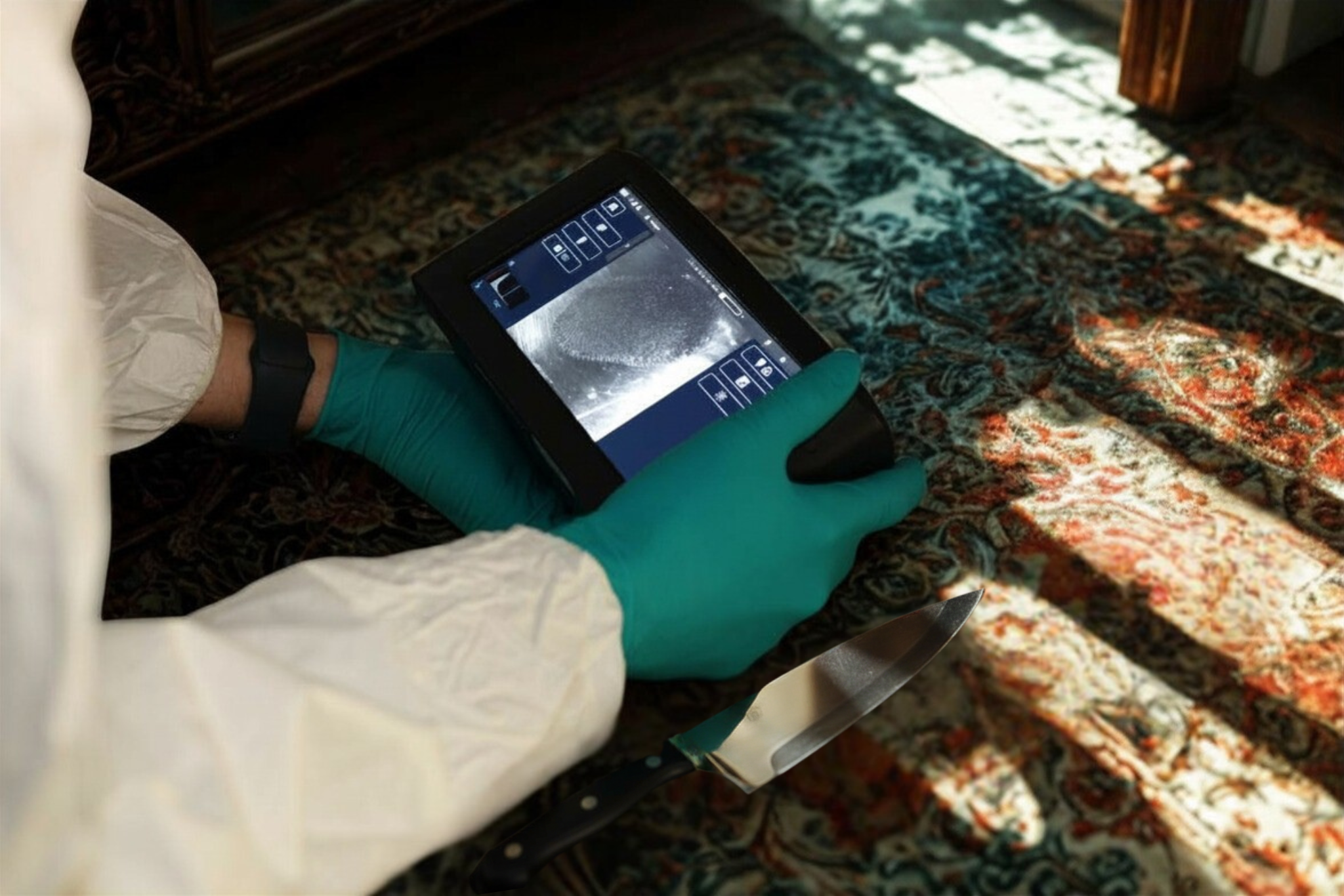
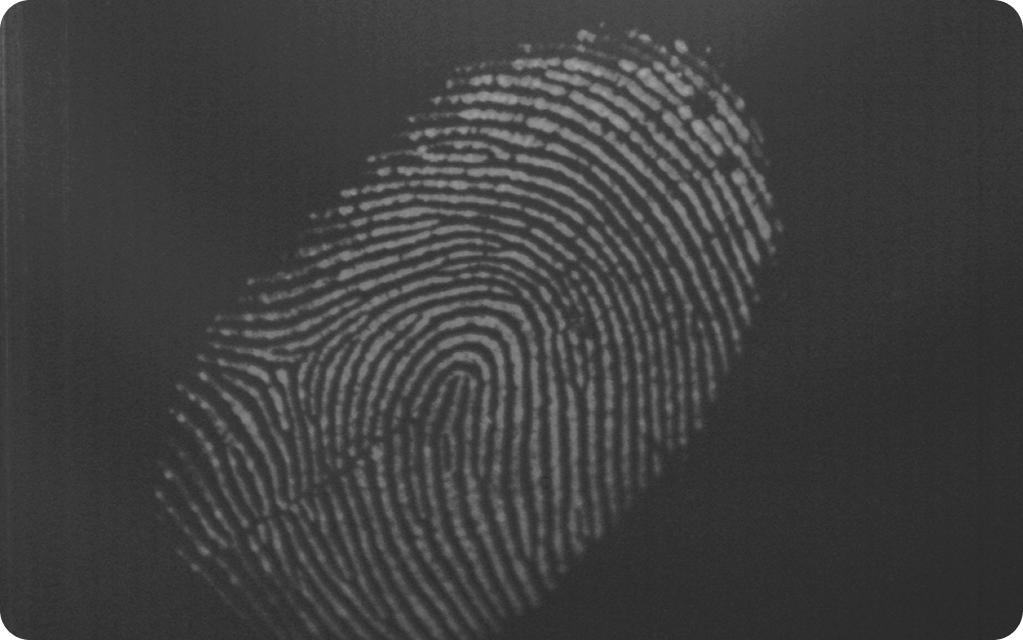
Built to support clearer visualisation in complex forensic environments.
High sensitivity imaging for high contrast visualisation
BlindSite Multi-Evidence integrates high sensitivity performance, providing high contrast visualisation at the scene.
It targets the absorption, fluorescence, reflectance, and scatter of both the fingerprint and the surface on which it has been deposited.
Frequently Asked Questions
Quick answers to common questions. If you don’t see what you’re looking for, please get in touch.
What is hyperspectral imaging, and how does it differ from multispectral imaging?
Hyperspectral imaging (HSI) is an advanced optical technique used in BlindSite. It is approximately 650 times more sensitive than the human eye, compared to multispectral imaging (MSI), which is around 10 times more sensitive. HSI captures extremely narrow wavelength bands (typically 1–10 nm), providing enhanced sensitivity. In contrast, multispectral imaging (MSI) uses broader wavelength bands (typically 50–100 nm). This allows HSI cameras, like BlindSite, to focus on specific peak wavelengths, producing higher-contrast responses and revealing evidence, such as latent fingerprints, that may be invisible to the naked eye.
Are there consumables or accessories required to use BlindSite?
No. BlindSite is a fully integrated solution that does not require ALS, chemicals, powders, or additional consumables or accessories, reducing both time and operational cost.
What is the benefit of a non-contact, non-destructive approach?
A non-contact, non-destructive (NCND) approach preserves evidence for further analysis. For example, BlindSite can capture a latent fingermark in situ without physical contact, enabling minutiae comparison while preserving the sample for potential DNA analysis, increasing the likelihood of identification. Similarly, for body fluids, BlindSite provides a targeted, NCND approach that allows investigators to collect vital DNA evidence without the risk of destroying, impairing, or compromising the trace, as can occur with more invasive methods.
Can BlindSite detect blood that would normally require luminol or other chemical techniques?
Yes. BlindSite can detect blood traces, including diluted samples. It detects haemoglobin through absorption (similar to luminol) and can also detect blood plasma via fluorescence, which luminol cannot. This increases detection capability and reduces false positives from substances such as bleach, rust, and household cleaners.
Does BlindSite only locate bodily fluids or also analyse them?
BlindSite locates potential bodily fluids and provides a preliminary indication (e.g., blood or semen), but it is not a confirmatory analytical tool. Its purpose is to enable rapid, targeted detection and digital capture in situ prior to collection, supporting investigation context and evidential integrity.